
Hardee Detention Facility Release Routes
Hardee County Sheriff's Office operates the Hardee County Detention Facility in Wauchula. It holds local arrestees awaiting first appearance, bond, case disposition, or transfer, along with people serving county sentences. An entry in the jail log therefore describes custody, not a conviction. A departure can have several meanings, and the HCSO release record is the source that should state when and why this facility stopped holding the person.
Community release may follow bond, an own-recognizance or pretrial order, a judge's direction, dismissal, time served, or expiration of a county sentence. The court docket shows the legal event. HCSO records the physical end of the jail stay. Those times can differ because the detention staff must receive the authority, check identity, review other holds, return property, and complete release paperwork.
Other departures are transfers. A felony sentence can move someone to the Florida Department of Corrections. Another county may take custody on a warrant. A federal writ, U.S. Marshals matter, or immigration hold can lead to another custodian. Ask for the receiving agency or destination whenever HCSO maintains it.
Confirm Hardee Detention Facility Releases
The correct first source is HCSO, not the state-prison locator. The sheriff's browser page directs users to the official mobile app for the jail arrest log. HCSO calls it a current-inmate or arrest-log channel and warns that information changes constantly. It does not promise a historical release archive or a set period of visibility after release.
- Open the HCSO inmate-search page and follow the official app route. Record the exact name, booking number, booking date, charge, bond information, and arresting agency while the episode is visible.
- Search the Hardee Clerk court record by case number when possible. Look for bond, dismissal, release orders, judgment, sentence, jail credit, probation, a warrant, or a capias.
- Ask the HCSO Records Custodian for the booking and release sheet or jail movement record tied to that episode. Request the actual release time, release authority or type, and any receiving agency.
- Use VINE as an event alert or cross-check. Confirm its event with HCSO when the legal release type or destination matters.
- Follow the receiving agency. If HCSO identifies FDC, another sheriff, federal authorities, or ICE, use that custodian's official system next.
The broader Hardee County released-inmate lookup explains how to continue when the booking date or custody system is uncertain. A no-result in FDC does not disprove a county-jail release because a short local stay may never enter state custody.
Hardee Detention Release Records Contact
HCSO centralizes public-record requests through its Records Custodian. A narrow request should identify one booking episode with the full legal name, aliases, date of birth, approximate booking date, arresting agency, and case or booking number when known. Ask for electronic delivery and a cost estimate before processing if cost matters.
HCSO Records Custodian
Mail or in person:
Hardee County Sheriff's Office
Attn: Custodian of Public Records
900 East Summit Street
Wauchula, FL 33873
Email: records@hardeeso.com
Phone: (863) 773-0304, extensions 230 or 269
Fax: (863) 773-4593
Inspection example: 8 a.m. to 5 p.m.
Requests may be sent by email, mail or in person, telephone, fax, or the official mobile app. The HCSO public-record page does not post a fixed ordinary release-record price or promise immediate production. Retrieval, legal review, redaction, format, and scope affect response time. Chapter 119 permits lawful copy costs and a reasonable service charge when extensive labor or technical resources are required.
Note: Do not reuse HCSO's crash-report price for a booking or release record because that posted charge applies to a different record.
Hardee Detention Facility Release Timing
HCSO publishes three separate time frames. Booking and bond information normally becomes available within one to two hours after the arresting officer arrives. That is an intake estimate. It does not forecast release. Once bond has posted or a judge has authorized release, HCSO says outgoing processing normally takes one to two hours.
Sentenced releases follow another schedule. A person with a Classification-approved release date normally leaves around 6 a.m. on that date. These are operating norms, not appointments. Identity verification, another warrant, a detainer, property processing, or other release work can change the actual gate time.
The HCSO booking questions page is the source for each distinction. Ask Detention for a time-sensitive status, then use the completed booking and release record for the final timestamp.
Note: Court authorization time and the Hardee detention release timestamp can differ without either record being wrong.
Hardee Detention Release Record Fields
A release record answers when and under what authority HCSO stopped holding the person. It is more precise than the live arrest log. Not every requested field will be public or stored in one document, and the custodian may redact exempt information. These fields make the request useful:
| Field | What it establishes |
|---|---|
| Name, aliases, and date of birth | Matches the response to the right person. |
| Booking or arrest number | Separates one custody episode from another. |
| Booking and release date/time | Defines the actual HCSO custody span. |
| Release authority or method | Explains whether bond, a court order, time served, sentence expiration, or another action ended custody. |
| Charges, bond, and surety details | Connects the jail episode to its court and bond history. |
| Detainer and receiving agency | Shows whether custody continued elsewhere. |
The Clerk record can show the case outcome and sentence, but the Clerk does not run the jail. Read both sources together. A dismissal also does not erase an arrest or booking record automatically.
Hardee Detention Facility Facts
The official HCSO detention page identifies the county operation behind this release route.
The agency source confirms that HCSO operates the detention facility, which is why county booking and release requests go to the sheriff rather than FDC.
HCSO's facility facts state that the sheriff complex opened in 1993. It has 215 inmate beds, 30 cells, and an internal courtroom connected to the courthouse. These figures describe the local detention setting, not Hardee Correctional Institution.
The HCSO facts and statistics source shows the local facility context.
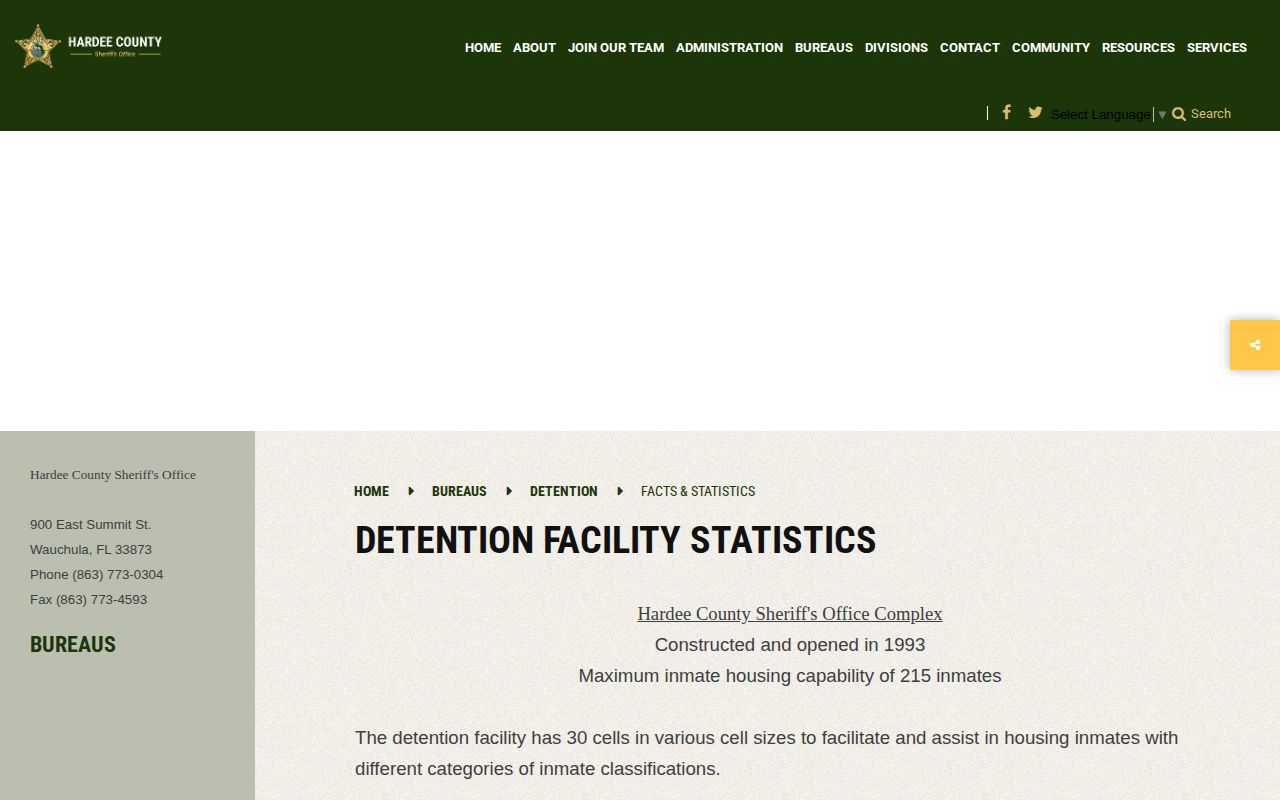
Those facts help distinguish the Wauchula county jail from the separate state-prison complex near Bowling Green.
Hardee County Jail or State Prison
Hardee County contains two systems with similar names. The Hardee County Detention Facility is the HCSO county jail in Wauchula. Hardee Correctional Institution and its Work Camp are FDC state-prison units in Bowling Green. They do not share a roster, release calculation, records office, or release search.
For the county facility, use the HCSO app, HCSO booking and release record, and Hardee Clerk docket. For Hardee CI, use FDC Inmate Population, Inmate Release Information, and Supervised Population records. A move from this detention facility to Hardee CI is a transfer into state custody, not a release to the community. Likewise, a changed FDC institution is not proof of prison discharge.
People at Hardee CI have FDC numbers and state-prison records. The Work Camp is a satellite part of that state complex, not a county work-release unit. A movement between the Work Camp and main institution remains an FDC transfer unless the state release record shows an actual release event.
This operator check should come before any name search. The county where a case began does not by itself identify which agency currently holds the person.
Hardee Detention Release Record Retention
App visibility is not the retention period. Florida's GS2 schedule gives booking records, Commitment and Release Lists, and inmate-incarceration records a minimum retention of one anniversary year after release. Jail Docket Books are permanent. Those minimums do not promise that every app entry or image remains online for the same period.
Chapter 119 requires access to existing nonexempt public records under reasonable conditions. If part of a release record is exempt, the custodian ordinarily redacts that part and produces the rest. The agency should identify the statutory basis for a withheld field. A focused request can ask which field was withheld instead of assuming the whole record was deleted.
For a calendar-day list, ask for the existing nonexempt Commitment and Release List for the named date. For one person, the booking and release sheet is more direct. HCSO does not need to create a new custom report that it does not maintain.
After Hardee Detention Facility Release
The release authority points to the next record. A person released on bond or by court order may have future court dates and conditions in the Clerk docket. A county sentence shown as time served or expired should align with the judgment, jail credit, and HCSO classification record. Probation can follow custody, but its supervising agency depends on the sentence.
A transfer requires a different follow-up. FDC becomes the source after a state-prison transfer. Another sheriff controls a receiving county-jail record. Federal or immigration custody calls for the named federal custodian's locator and records. VINE can supply a prompt event notice, but the agency that created the release or transfer record remains the source for the date, type, and destination.