
Hardee County Projected Release Dates
A projected date is an estimate based on the custody record, sentence, lawful credit, and rules that apply to that person. Florida's state-prison term is Tentative Release Date, often shortened to TRD. It is the date FDC projects for release from custody after gain-time has been granted or forfeited. It is not a promise. The maximum sentence expiration date is a different calculation based on the imposed term and lawful jail credit.
An actual release date records a completed departure from the named agency. FDC's Inmate Release Information record can show that later event for state custody. For Hardee County Detention Facility, HCSO's booking-and-release record is the direct source for the physical release time and release authority. A release from one agency may also be a transfer to another agency, so the destination field matters.
A pretrial detainee does not have a sentence-based release date. Release may depend on bond, a court ruling, case disposition, identity checks, or other holds. The Hardee Clerk docket can show the legal event, but HCSO records the physical jail departure.
Find Hardee County Release Dates
Start with the operator, not just the word Hardee. HCSO runs the Hardee County Detention Facility in Wauchula. FDC runs Hardee Correctional Institution and its Work Camp near Bowling Green. A county-jail booking and a state-prison sentence use different databases, credit rules, and release records.
- Identify the last known facility and decide whether HCSO or FDC held the person.
- For current state custody, open the FDC Inmate Population Search and match the six-character DC number, identity fields, institution, and sentence data.
- Read the field labeled Tentative Release Date. Record the date checked because FDC updates release-date changes nightly.
- For a completed state release, switch to FDC Inmate Release Information and compare the actual release history.
- For a county sentence, ask HCSO Classification for the approved release date and compare the Hardee Clerk judgment and jail-credit terms.
- For a pretrial case, follow the Clerk docket and HCSO booking record instead of trying to calculate a sentence date.
The FDC Corrections Offender Network menu keeps Inmate Population, Inmate Releases, and Supervised Population separate. That design helps prevent a current projection from being mistaken for an old discharge or a present supervision record.
The official menu shows the distinct state databases used in a Hardee County release-date lookup. Review the FDC offender-search source before selecting a search.
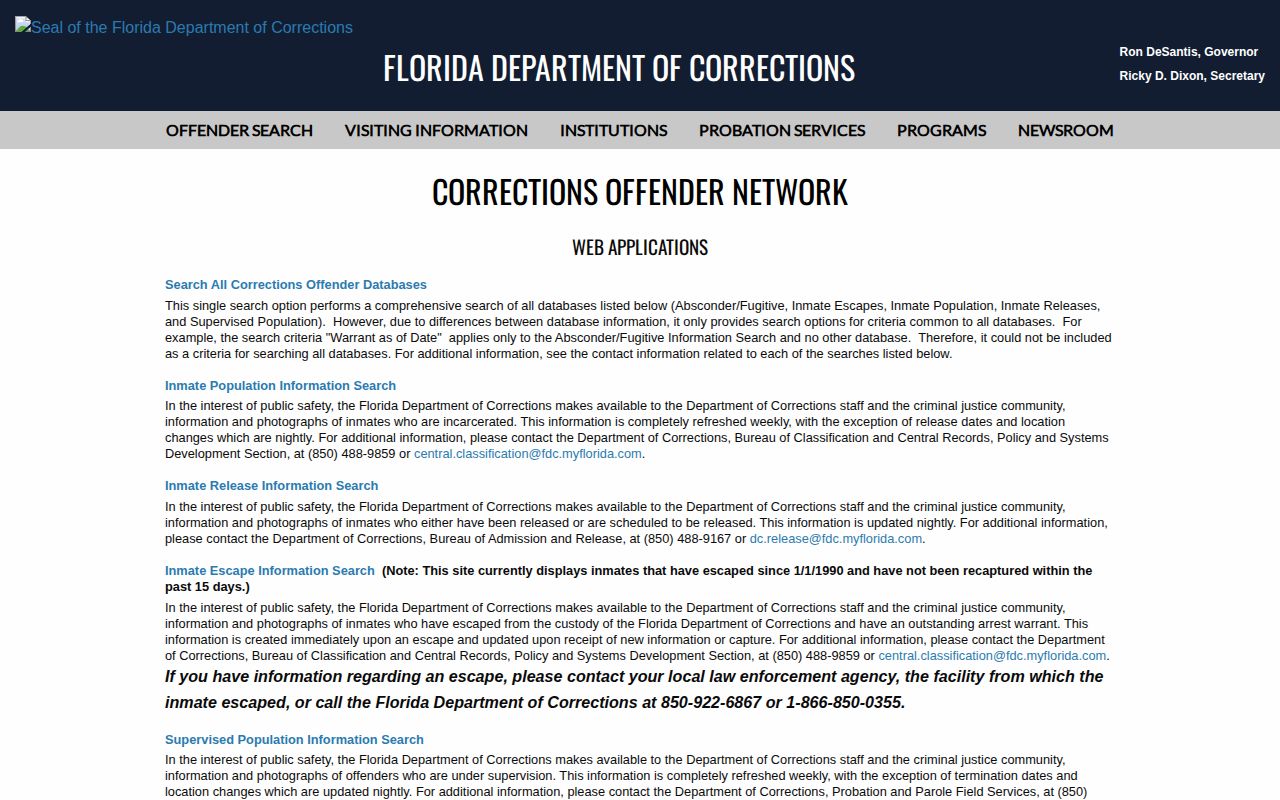
Choosing the database that matches the custody stage is the first control against a false date.
Note: A no-result in FDC can be correct when the entire Hardee County custody episode stayed in the county system.
Hardee County State Release Date
Use the FDC Inmate Population Search for a person currently serving a state-prison sentence. A DC number is the strongest search key. If only a name is available, open the detail and compare date of birth, physical description, photo, convictions, county and case details, and institution. Similar names are not enough.
The detail can display the Tentative Release Date when one applies. Some life sentences do not have a conventional TRD. A mandatory minimum, sentence that requires full service, or other legal limit may also constrain the date. FDC says release dates and location changes are updated nightly, while much of the broader population data is refreshed weekly. Cite the date of the check whenever the projection is recorded.
The public FDC population form is the gateway to that official field. Open the current-inmate search source and select only a correctly matched public record.
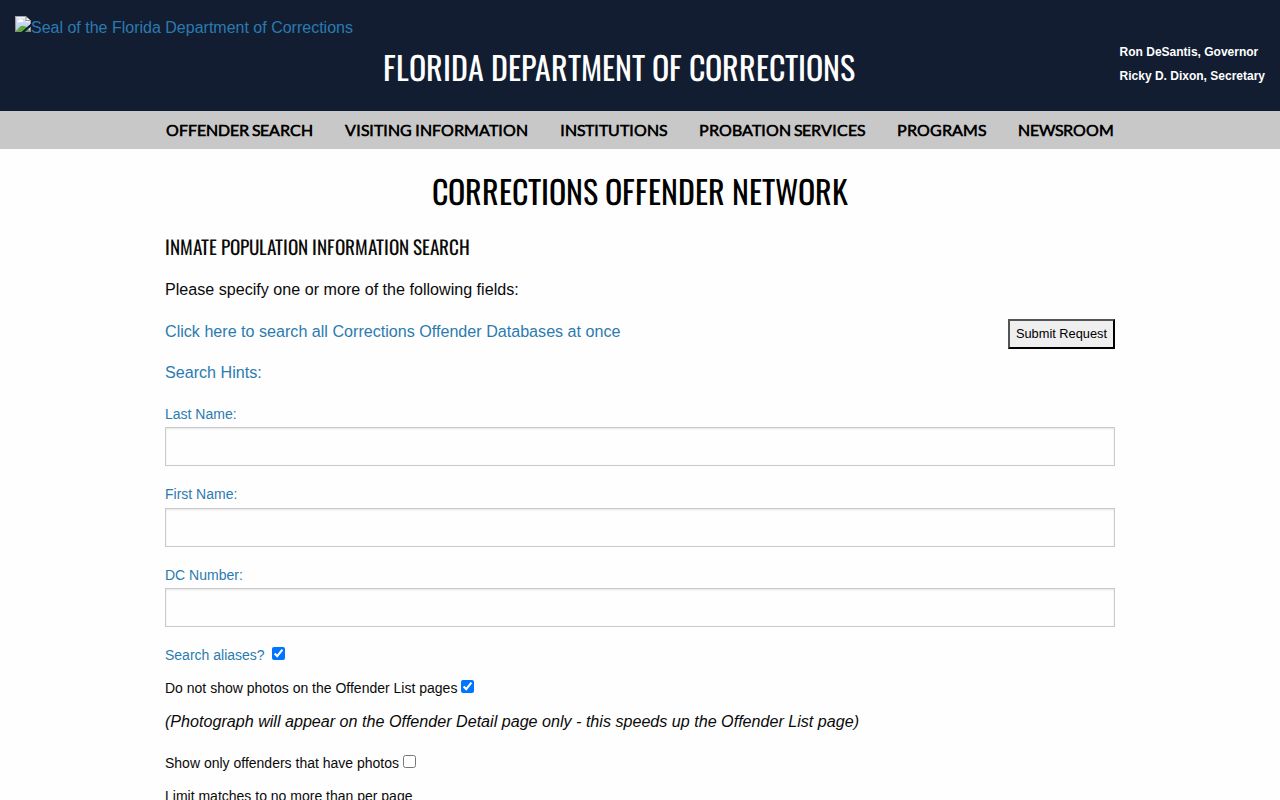
A result must be read as a projection current on the day checked, never as a guaranteed pickup time.
Florida State Release Date Calculation
Florida Statutes section 944.275 defines the key state-prison calculations. FDC first establishes a maximum sentence expiration date for a term-of-years sentence, reduced by lawful credit such as court-awarded jail credit. FDC then establishes the TRD from gain-time granted or forfeited under the statute. Gain-time is a lawful sentence credit. It is not the same as the credit a judge awards for days already spent in jail.
For most offenses under the modern rule, ordinary gain-time cannot move release earlier than the point at which the prisoner has served 85 percent of the imposed sentence. Time physically incarcerated and credited by the court counts toward that floor. The rule means “at least 85 percent” for the covered sentence, not “release at exactly 85 percent.” Mandatory minimum terms, consecutive sentences, life sentences, offense-specific restrictions, and other laws can require more time.
A simple ten-year illustration begins with the maximum-expiration calculation and applies lawful jail credit. If the modern floor governs, ordinary gain-time cannot reduce custody below 8.5 years of the imposed term, counting qualifying physical jail credit. That is only an illustration. FDC and the sentencing record must resolve offense dates, concurrent or consecutive terms, corrected credit, mandatory minimums, and later violations.
The statute screenshot preserves the source for the formal TRD and service-floor rules. Read the state gain-time statute with the record.
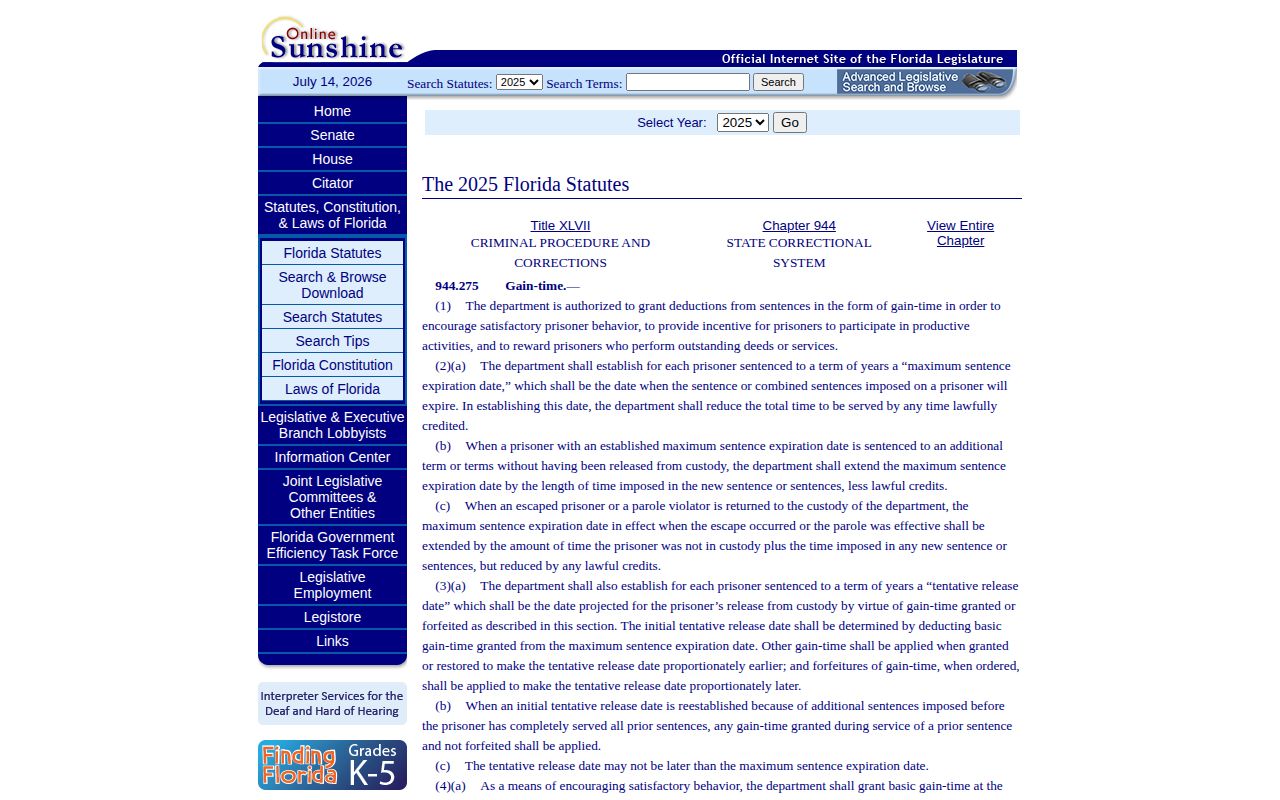
The statute explains why an FDC date is computed and tentative rather than a fixed calendar promise.
Note: Court-awarded jail credit can count toward the service floor, but it does not erase other sentence limits.
Hardee County Release Date Changes
A TRD can move when the facts or credits in FDC's calculation change. The public field should therefore be checked again near the projected date. A past screenshot cannot override a current sentence record or later legal event.
| Factor | Possible effect | Source to check |
|---|---|---|
| Gain-time award | May advance the TRD within lawful limits | Current FDC detail and central records |
| Disciplinary forfeiture | May move the TRD later | FDC calculation and authorized order |
| Restored or deleted gain-time | May revise the projection again | FDC record |
| Corrected judgment or jail credit | Changes the base sentence calculation | Court order and FDC record |
| New or consecutive sentence | Can extend maximum expiration | Court docket and FDC sentence data |
| Escape or qualifying violation period | Can extend the calculation | FDC record and order |
| Detainer or outside hold | May change destination even when FDC releases | FDC detainer data and receiving agency |
Parole also needs precise language. An FCOR agenda or favorable intermediate action is not a completed prison release. Obtain the final order, then check FDC's release record. A transfer, detainer, or another agency's hold may mean the person left FDC but did not enter the community.
Hardee County Jail Release Calculation
A sentence at the Hardee County Detention Facility is not calculated under FDC's state-prison formula. Florida Statutes section 951.21 supplies a separate county-prisoner good-conduct framework. Unless a county commission has revised or discontinued the policy, it authorizes up to five days per month in the first and second years, up to ten days per month in the third and fourth years, and up to fifteen days per month in later years when the statutory conduct terms are met. The law also addresses extra credit and forfeiture.
No current Hardee County resolution or HCSO policy was found that confirms the exact local implementation. That missing local authority matters. Do not apply the FDC 85-percent floor to a Hardee county-jail sentence. Do not promise the maximum credit in section 951.21. Ask HCSO Classification for the approved date and ask the Hardee Clerk for the judgment, term, and jail-credit order.
The official county-prisoner statute shows why the two calculations must stay apart. Review the county gain-time source before drawing any estimate.
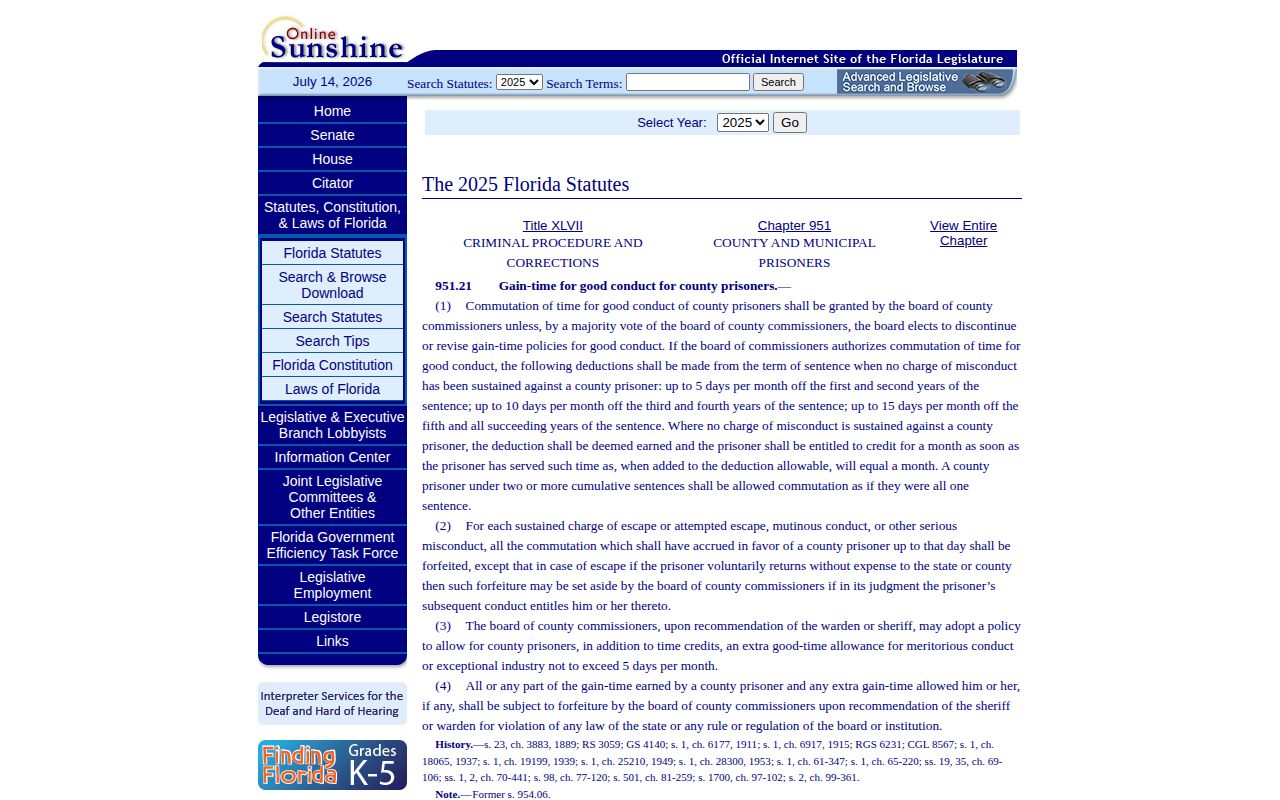
The separate statute confirms that a county release date cannot be copied from the state-prison 85-percent framework.
Hardee County Sentenced Release Time
HCSO publishes one useful local timing fact. A sentenced person with a release date approved by Classification is normally released around 6 a.m. That statement concerns the usual processing time after an approved county date. It does not create the date, override a warrant or hold, or guarantee departure at a fixed minute. Bond and judge-authorized releases follow another workflow and are usually processed in one to two hours after authorization.
Keep the clocks separate. Intake and posting of charge or bond data usually take one to two hours after the arresting officer arrives. Outgoing bond or judge-release processing has its own one-to-two-hour norm. Sentenced release uses the early-morning norm after Classification approves the date. None of those timing statements proves the final destination.
Note: A judge's order can authorize release before identity checks, paperwork, property return, and outside-hold review are complete.
Confirm Hardee County Actual Release
For an already released state prisoner, use FDC Inmate Release Information. Its actual release history supersedes an earlier screenshot of a TRD. If post-prison supervision follows, keep the supervision start and end dates separate. For a county release, request the HCSO booking-and-release record with release date and time, release type or authority, and destination or receiving agency.
VINE can add fast notice of a reported event, but it is not the final sentence calculation. The Hardee County VINE inmate check explains the specific-person and alert path. Confirm the event with the reporting agency when a transfer or outside hold is possible. For a full county search and record request route, use the Hardee County released-inmate record search.
A clean timeline labels each field by agency: court sentence and jail credit from the Clerk, county release time from HCSO, state TRD and actual prison release from FDC, and any supervision dates from FDC or FCOR. That method turns a vague estimate into a record trail without treating any single screen as more than it proves.